புதன், 10 ஏப்ரல், 2013


OSHO ON RAMANA MAHARISHI
Osho on Ramana Maharshi Enlightenment, Ramana Maharshi Self Realization

Ramana Maharshi
Osho – LIE DOWN AS DEAD. Try it: suddenly you have gone dead. Leave the body! Do not move it, because you are dead. Just imagine that you are dead. You cannot move the body, you cannot move the eyes, you cannot cry, you cannot scream, you cannot do anything, you are just dead. And then feel how it feels.
But do not deceive. You can deceive – you can slightly move the body. Do not move. If some mosquito is there, then treat the body as if it is dead. It is one of the most used techniques. Raman Maharshi attained his enlightenment through this technique, but it was not a technique used by him in his life.
In his life it suddenly happened, spontaneously. But he must have persisted with this in some past life, because nothing happens spontaneously. Everything has a causal link, a causality. Suddenly one night Raman felt – he was just young, fourteen or fifteen at the time – that he was going to die. And it was so certain in his mind that death had taken over. He couldn’t move his body, he felt as if he was paralyzed.
Then he felt a sudden choking, and he knew that now the heart was going to stop. He could not even cry and say to another, ”I am going to die.” Sometimes it happens in some nightmare – you cannot cry, you cannot move. Even when you become awake for a few moments you cannot do anything. That happened.
He had absolute power over his consciousness, but no power over his body. He knew he was there, that he was present, conscious, alert, but he felt he was going to die. And the knowledge became so certain that there was no other possibility, so he just gave up. He closed his eyes and remained there, just waiting to die; he waited there just to die.
By and by the body became stiff. The body died, but then it became a problem. He knew that the body had died, but he was there and he knew it. He knew that he was alive and that the body had died. Then he came back. In the morning the body became okay but the same man never returned – because he had known death. He had known a different realm, a different dimension of consciousness.
He escaped from the house. That death experience changed him completely. He became one of the very few enlightened persons of this age. This is the technique. This happened spontaneously to Raman, but it is not going to happen spontaneously to you. But try it. In some life it may become spontaneous. It may happen while you are trying it. And if it is not going to happen, the effort is never wasted. It is in you; it remains in you as a seed.
Sometime, when the time is ripe and the rains will fall, it will sprout. Every spontaneity is just like this. The seed was sown some time ago, but the time was not ripe; there were no rains. In another life the time becomes ripe. You are more mature, more experienced, more frustrated with the world – then suddenly, in a certain situation, there are rains and the seed explodes.
செவ்வாய், 9 ஏப்ரல், 2013
OSHO ON CHILDREN AND PARENTING
Osho – Every child is born clever. No child is ever born idiotic

Osho – Every child is born clever. No child is ever born idiotic. To become an idiot one needs to be educated. To convert people to idiocy, schools and colleges and universities are needed. It is a great achievement. Idiocy is not natural; it has to be learned, it has to be earned. Great effort has to be made before you can become stupid. A Buddha or a Lao Tzu or a Jesus are people who somehow escaped from society, who somehow managed it that society did not change them into stupid people. They look rare because the whole society has become stupid otherwise they would be the norm. It be natural to be clever, intelligent — as natural as breathing, as natural as health.
Watch a child, any child, black, white, Indian, Chinese, German — yes, even German! Watch any child. All children are intelligent and all children are beautiful. Have you ever seen an ugly child? The phenomenon does not exist at all. Have you ever seen a stupid child? Their intelligence is tremendous.
But society starts to cripple the child because society cannot allow that much intelligence. That much intelligence is dangerous. An intelligent child is a dangerous person. Society immediately jumps upon the child, from the very first day. The child is not even allowed the freedom to breathe on his own — the doctor slaps him on his bottom and society has started. The child is not even allowed to breath on his own. You should wait. There is no need to slap the child.
Go and watch in a maternity home. When the child is born, the doctor will take the child by his legs, hold him upside down and slap him on the bottom to help him breathe. It is as if nature is not enough so your help is needed. Nobody slaps the animals — yet they are breathing, breathing beautifully. No doctor is needed, no nurse is needed, no mid-wife is needed.
Wait! But society cannot wait. Within seconds society enters. Society has to slap the child. And now people who have been studying the phenomenon of slapping the child say that the first slap comes as a shock, because the child is very delicate. For nine months he has lived in a very protected environment — that slap is like a great shock. With a shock his life starts.
Then there are even more cruel people. Jews will do a circumcision — it is a great shock to cut the foreskin of the genital organs. You have started violence, you have started butchering the child. Society is on the way.
And immediately everything has to be forced on the child. Now the mother is told when to breast-feed the child and when not to breast-feed the child — after three hours. As if every child is a Ford car, just like every other Ford car. Each child is an individual. His needs are different. One child will find that he is hungry within two hours, another child will find that he is not hungry after five hours. This average of three hours is dangerous. One child will not be hungry but the mother will force him to feed because three hours are over and another child will be hungry and crying and weeping but the mother will wait and look at the clock and because three hours are not over yet how can she feed him?
These are subtle tricks to destroy the delicate intelligence, the delicate life of the child. Then he has to be trained about everything. From toilet training to God, he has to be trained about everything. He is not allowed any spontaneity. And intelligence thrives in spontaneity, intelligence dies in discipline. The more disciplined the child, the more stupid he will be; the more intelligent the child, the more rebellious he will be. Rebelliousness and intelligence are synonymous; stupidity and discipline are synonymous. If you have succeeded in ordering the child to obey you and in making him conform to your ideas, you have succeeded in killing his intelligence.
Your schools, your colleges, your universities, all teach nonsense because they are all against sense. Nowhere is sensitivity taught nowhere. In fact, sensitivity has to be destroyed. It is dangerous to allow the child to be sensitive and intelligent because, if the child remains sensitive, then society will not be able to force the child to do foolish things throughout his life.
For example: a person goes on being a clerk his whole life, just piling up files. To do such a thing you need to be very insensitive. If you have a certain sensitivity you will want to break out of this nonsense, you will want to go into the fields, into the forest. You may want to become a gardener, you may want to become a farmer, or a fisherman, or a carpenter, or a sculptor, or a poet — but you will not want to become a clerk in an office. For what should one want to be a clerk? The sun is so bright and the flowers have bloomed and the birds are singing and you are just doing a clerical job! It will not be possible. Society has to kill your intelligence, your sensitivity, so that you can be put into any job.
When you are dull it is easy to force you into any direction. Then a person can keep on doing any nonsense job. And when you do a nonsense thing for your whole life, naturally. by and by, you lose all possibilities of being intelligent.
A person can be sent into the army. If people were in-telligent who would go into the army? For what would they kill others and be killed? Life is to live, not to be killed and not to kill. Life is to enjoy; it is a divine gift. But millions of people are in the army, just getting ready to be butchered or to butcher. And their whole life — from morning to evening — is spent parading, polishing their rifles, following some foolish man’s orders: left turn, right turn. Doing this their whole life! And not even for a single moment do they think about what they are doing — what they are doing with their life. Is life meant for this? Is this the destiny of life?
If you are singing and dancing maybe it is meaningful,. but turning left and right, doing the same march every day. just preparing for death…. How can life be just a preparation for death? Brutality, violence, insensitivity is taught only then can millions of people be turned into slaves. You think you are free people? Slavery has just become more sophisticated, that’s all. Slavery still exists. No society up to now has ever been a free society. All societies have been slave societies.
Yes, one thing is certain: slavery changes its forms. First it was very gross, now it is very subtle. And remember. subtle slavery is far more dangerous than gross slavery — because you can rebel against gross slavery, it is so apparent. so obvious, but when the slavery is very subtle then you are not even aware of it. If you are a Mohammedan, if you are a Hindu, if you are a Christian, if you are a Jaina, you are a slave. Your mind has been conditioned to be a Hindu, to be a Mohammedan, to be a Christian, and you have become that.
And you have never thought about it. Why should you be a Christian? Why should you be a Mohammedan? You were not born as a Christian, as a Mohammedan, you were born as pure consciousness. Why these limitations? Who has forced these limitations on you? You were born as a pure human being — who has made you an Indian and who has made you Chinese? You are slaves. If you are Chinese or Indian or English, you are a slave. Slavery is very subtle.
And if you are doing things which others want you to do and you never do the thing that you always wanted to do, you are a slave. You go on loving a person you don’t love, you go on sleeping with a person you don’t love, you go on living in a relationship which is simply destructive, horrible, a hell, but you go on. You are a slave, you are not a free man.
A free man is one who claims back his intelligence, who claims back his sensitivity. To me, that is what sannyas is: to claim back your intelligence, to claim back your sensitivity, to become again sensuous, alive, to become again intelligent, to become again a child.
திங்கள், 8 ஏப்ரல், 2013
OSHO ON EGO
Osho – The only problem is the ego, but it creates thousands of other problems
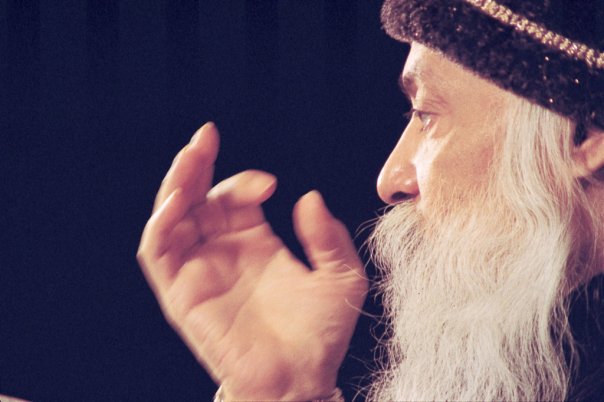
Osho – The only problem is the ego, but it creates thousands of other problems; it is the root cause. And I am not interested in pruning the leaves and the branches — cut the root — because that is a futile effort, cutting leaves and branches; they will grow again. And all the religions have become too much concerned with the leavres and the branches, and by cutting them nothing is going to happen.
The problem with the roots is that they are always underground; you cannot see them. And that’s how ego is, it is always underground. You see greed, you see anger, you see sex, you see ambition; these are all above the ground. Jealousy, possessiveness, domination, they are all above the ground. But they are only symptoms. And never treat the symptoms — cut the root, go to the very root, and then in a single blow life can be transformed.
The ego is a false entity. It is an invented centre which exists not. It is a cheap way to create some identity. To discover the real centre needs courage, needs deep meditation, needs inner searching, a soul-searching. So people have found a short-cut: rather than finding the real centre they create a plastic centre. It is cheap, easy. That’s what ego is. Ego simply means you don’t know who you are, still you think you know.
This false knowing has to be dropped. It is better to accept that you don’t know; that is a first step towards truth. Dionysius calls it “agnosia”, a state of not-knowing.
So these are the three states: ignorance…. In ignorance a person does not know but thinks he knows. The second is agnosia: a state of not-knowing. A person still does not know, but he knows that he does not know — and that is a tremendous growth. And the third is realisation, enlightenment, awakening Buddhahood, when a person knows that he knows.
Millions are living in the first state. Sannyas means moving to the second. And then the third comes or its own, you need not do anything. You just remain in the second, watching so that the first does not come in from some back door. Remain in a state of not-knowing, remain innocent, childlike, wondering about it all but not creating false knowledge to hide your ignorance, and the ego disappears.
The moment the ego disappears your real being reveals itself. And then there is light and then there is abundant life and then there is an infinity of love overflowing. By going beyond the ego one goes beyond both time and space and enters into the ultimate. Less than that cannot satisfy, less that that is not worthwhile. This is the goal for a sannyasin — the ultimate realisation of god or truth or nirvana.
OSHO
Osho – The seeker has to be silent, then god speaks.

Osho – One can be in an argument with existence or one can be in a dialogue. When you are in argument with existence you are fighting, you are trying to prove yourself right and existence wrong. When you are in a dialogue there is no question of proving yourself right or existence wrong. There is no a priori idea; you are just in communion. You are in search of truth.
The argumentator already thinks he knows the truth. He is not a seeker. He already believes in the truth, he is not an explorer. He believes that he has found, although that belief is absolutely unfounded, It is not true. He has just accumulated ideas which are floating in the air, from the scriptures, from the traditions, from people around, and he is trying to convince himself and others that these ideas are his. In fact no thought is yours — they are all unoriginal. Thought as such is never original; no-thought is original.
If you are in an argument with existence then you are trying to prove your thought, right and existence is absolutely silent: you can go on imposing your ideas — existence will not refute them, remember. For thousands of years people believed that the earth is flat. The earth never denied it, not even once.
People believed that the sun goes around the earth, and the sun never denied it — -who bothers? Do you bother what mosquitoes go on thinking about you? Nobody bothers whether the mosquitoes think that Jesus is the messiah or not, whether Mohammed is the prophet or not, whether Buddha is really enlightened or not. In the same way existence has no interest in what man thinks.
But a miracle happens, the moment you are silent, the moment you are open, not trying to prove something, not trying to say something to existence but ready to listen, available, existence immediately becomes immensely interested in you. It opens up its heart, it allows you to enter into its mysteries — that is Samvado.
The seeker has to be silent, then god speaks. If you speak then god remains silent. Only one can speak. If you want to listen to the voice of existence itself then learn the art of being silent. Then disappear completely. Then just be there, available, open, receptive, and you will be flooded with truth, with light and that light, that truth, will liberate you, will make you what you are supposed to be, what you intrinsically need to be. Your real destiny will be fulfilled. You will feel immense gratefulness and tremendous contentment. But one has to learn the art of being silent, then a dialogue with existence happens.
Martin Buber, one of the most important Jewish thinkers of this age, has written a famous book, I AND THOU, and he propounded the idea that prayer is an I-Thou dialogue. But he was just a thinker not a mystic — a philosopher but not a Buddha. He came very close, he almost stumbled on the truth — but stumbled. He guessed approximately but missed too.
As far as the word ‘dialogue’ is concerned he is absolutely right, prayer is a dialogue. But when he said it is a dialogue between I and Thou he missed the point. It is not a dialogue between I and Thou, because if I and Thou are there, there is going to be an argument. I and Thou can only fight and argue; a dialogue is not possible. The very idea of I is argumentative. The I says ‘I am right; how can you be right?’ So the word ‘dialogue’ that he has come across is beautiful but it is only guesswork, so he can be forgiven.
When real dialogue happens there is only Thou, no I. That is the beginning of dialogues the I disappears, there is only Thou. And then the end of the dialogue is when Thou also disappear, there is complete silence. Jalaluddin Rumi, one of the most significant Sufi mystics, has reached a little deeper than Martin Buber. In his famous poem a lover knocks on the door of his beloved, and the beloved asks from inside ‘Who are you?’ He says ‘Cannot you guess by my voice, by my footsteps?’ And the beloved says ‘If you still are that much then this house is very small — it cannot contain two. When you have completely disappeared come back.’
And the lover goes and moves into the forest. Moons come and go, days pass, months pass, years pass, and one day he is no more. So Rumi says he comes back and knocks on the door. There is the same question again ‘Who are you? He says ‘I am no more — only you are, and the door opens, he is received.’
He goes a little deeper than Martin Buber but as far as I am concerned it too is only the beginning, not the end. If I am to write the poem or if I meet Jalaludin Rumi then I will insist on his changing it, adding something more to it; it is half. He must have written it in his early days. He must have written it when he had attained only the experience of satori, not of samadhi, because if the man had really dropped his ego who would be there to come back and knock on the door? I would change this much, the last part.
The first part is beautiful: years pass and slowly slowly he disappears. Then there is nobody to come back. Now the beloved comes in search of him — that would be my end of the story. She comes and shakes him up out of his meditation saying, ‘What are you doing? I have been waiting and waiting and waiting.’
And he asks ‘Who are you?’ ‘Come only when the I has disappeared.’ Then the story will be complete, then the dialogue is absolute when both have disappeared. Then there is unity, then there is communion, union — neither I nor thou. Martin Buber says prayer is an I-Thou dialogue, Jalaluddin Rumi says prayer is no I but only Thou; I say no I, no Thou, then there is dialogue. And that dialogue is the ultimate goal of all religiousness.
OSHO ON MAHATMA GANDHI
Osho on Mahatma Gandhi, Osho meets Mahatama Gandhi

Osho : Hundreds of times we had discussed Mahatma Gandhi and his philosophy, and I was always against. People were a little bit puzzled why I was so insistent against a man I had only seen twice, when I was just a child. I will tell you the story of that second meeting….
I can see the train. Gandhi was traveling, and of course he traveled third class. But his “third class” was far better than any first class possible. In a sixty-man compartment there was just him and his secretary and his wife; I think these three were the only people. The whole compartment was reserved.
And it was not even an ordinary first-class compartment, because I have never seen such a compartment again. It must have been a first-class compartment, and not only first class, but a special first class. Just the name plate had been changed and it became “third class” so Mahatma Gandhi’s philosophy was saved.
I was just ten. My mother–again I mean my grandmother–had given me three rupees. She said, “The station is too far and you may not be back in time for lunch, and one never knows with these trains: it may come ten hours, twelve hours late, so please keep these three rupees.” In India in those days, three rupees was almost a treasure. One could live comfortably for three months on them.
She had made a really beautiful robe for me. She knew I did not like long pants; at the most I wore pajama pants and a kurta. A kurta is a long robe which I have always loved, and slowly slowly the pajama has disappeared, only the robe remains. Otherwise one has not only divided the upper body and the lower body, but even made different clothes for each. Of course the higher body should have something better, and the lower body is just to be covered, that’s all.
She had made a beautiful kurta for me. It was summer and in those parts of central India summer is really difficult because the hot air going into the nostrils feels as if it’s on fire. In fact, only in the middle of the night can people find a little rest. It is so hot in central India that you are continuously asking for some cold water, and if some ice is available then it is just paradise. Ice is the costliest thing in those parts, naturally, because by the time it comes from the factory, a hundred miles away, it is almost gone. It has to be rushed as quickly as possible.
My Nani said I should go to see Mahatma Gandhi if I wanted to and she prepared a very thin muslin robe. Muslin is the most artistic and the most ancient fabric too, as far as clothes are concerned. She found the best muslin. It was so thin that it was almost transparent. At that time gold rupees had disappeared and silver rupees had taken their place. Those silver rupees were too heavy for the poor muslin pocket. Why am I saying it?–because something I’m going to say would not be possible to understand without it.
The train came as usual, thirteen hours late. Almost everybody was gone except me. You know me, I’m stubborn. Even the stationmaster said, “Boy, you are something. Everybody has gone but you seem ready to stay the whole night. There is no sign of the train and you have been waiting since early this morning.”
To come to the station at four o’clock that morning I had to leave my house in the middle of the night. But I had not yet used those three rupees because everybody had brought so many things with them, and they were all so generous to a little boy who had come so far. They were offering me fruits, sweets, cakes and everything, so there was no question of feeling hungry. When the train finally arrived, I was the only person there–and what a person! Just a ten-year-old boy, standing by the side of the stationmaster.
He introduced me to Mahatma Gandhi and said, “Don’t think of him as just a boy. The whole day I have watched him, and I have discussed many things with him, because there was no other work. And he is the only one who has remained. Many had come but they left long ago. I respect him because I know he would have stayed here till the last day of existence; he would not leave until the train arrived. And if the train had not arrived, I don’t think he would ever have left. He would have lived here.”
Mahatma Gandhi was an old man; he called me close and looked at me. But rather than looking at me, he looked at my pocket–and that put me off him forever. And he said, “What is that?”
I said, “Three rupees.”
He said, “Donate them.” He used to have a box with a hole in it by his side. When you donated, you put the rupees in the hole and they disappeared. Of course he had the key, so they would appear again, but for you they had disappeared.
I said, “If you have the courage you can take them. The pocket is there, the rupees are there, but may I ask you for what purpose you are collecting these rupees?”
He said, “For poor people.”
I said, “Then it is perfectly okay.” And I myself dropped those three rupees into his box. But he was the one to be surprised, for when I started leaving I took the whole box with me.
He said, “For God’s sake, what are you doing? That is for the poor!”
I said, “I have heard you already, you need not bother repeating it again. I am taking this box for the poor. There are many in my village. Please give me the key; otherwise I will have to find a thief so that he can open the lock. He is the only expert in that art.”
He said, “This is strange….” He looked at his secretary. The secretary was dumb, as secretaries always are; otherwise why should they be secretaries? He looked at Kasturba, his wife, who said, “You have met your equal. You cheat everybody, now he is taking your whole box. Good! It is good, because I am tired of seeing that box always there, just like a wife!”
I felt sorry for that man and left the box, saying, “No, you are the poorest man, it seems. Your secretary does not have any i ntelligence, nor does your wife seem to have any love for you. I cannot take this box away–you keep it. But remember, I had come to see a mahatma, but I saw only a businessman.”
That was his caste. In India, baniya, businessman, is exactly what you mean by a Jew. India has its own Jews; they are not Jews, they are baniyas. To me, at that age, Mahatma Gandhi appeared to be only a businessman. I have spoken against him thousands of times because I don’t agree with anything in his philosophy of life.
OSHO ON RAMANUJAN
Osho on Ramanujan and Professor Hardy

Ramanujan
Osho – In the 1888 a person named Ramanujan was born in a poor Brahmin family in South India. He became a very famous mathematician. He could not study much, but still his genius in mathematics was unique. Many well educated mathematicians have earned a name because of their training and guidance from others for a number of years. But Ramanuja, was not even a matriculate and had no training or guidance from anyone.
With great difficulty he got a clerical job, but very soon news spread that he had an amazing talent in mathematics. Someone suggested that he write a letter to the famous mathematician, Professor Hardy, of Cambridge University – he was the most eminent mathematician of those days. He didn’t write a letter, but solved two theorems of geometry and sent them to Professor Hardy. Hardy was astonished to receive them and could not believe that someone so young could solve such theorems.
He immediately wrote back to Ramanujan and invited him to England. When Hardy met him for the first time, he felt that he was like a child before Ramanujan in the field of mathematics. The genius and capabilities of Ramanujan were such that they could not be due to mental powers, because the intellect moves very slowly, thinking takes time, but Ramanujan didn’t take any time in responding to Hardy’s questions. No sooner was the problem written down on the blackboard or put to him verbally than Ramanujan began to reply, without any time gap for thinking. It was very difficult for great mathematicians to understand how it happened. A problem which would take about six hours for an eminent mathematician to solve – and then too he was not sure about being right – Ramanujan solved instantaneously, unerringly.
It proved that Ramanujan was not replying through the medium of the mind. He was not very learned, he had actually failed in matriculation; there was no other sign of intellectual ability, but in connection with mathematics he was superhuman. Something happened that was beyond the human mind. He died when he was thirty-six because of tuberculosis.
When he was in hospital, Hardy, along with two or three other mathematician friends, went to see him. As it happened, he parked his car in such a place so that Ramanujan could see its number plate. When Hardy went into Ramanujan’s room, he told Hardy that his number plate was unique: it had four special aspects to it. After that, Ramanujan died. Hardy took six months to understand what Ramanujan meant, but he could only discover three of the four aspects. On his death he left a will that research work on that number should continue, to find out the fourth aspect. Because Ramanujan had said there was a fourth, there had to be. Twenty-two years after Hardy’s death, the fourth was discovered. Ramanujan was right.
Whenever he began to look into any mathematical problem something began to happen in the middle space between his two eyebrows. Both his eyeballs turned upwards, centering on that middle space. In Yoga, that space is described as the third eye spot. It is called the third eye because if that eye becomes activated it is possible to see events and scenes of some different world in their entirety.
It is like looking out of your house through a small hole in the door, and suddenly, when the door opens, you see the whole sky. There is a space between the two eyebrows where there is a small aperture which sometimes opens – as in the case of Ramanujan. His eyes rose to his third eye while solving a problem. Neither Hardy could understand this phenomenon nor would other Western mathematicians ever understand it in the future.
Source – Osho Book “Dimensions Beyond the Known”
இதற்கு குழுசேர்:
கருத்துகள் (Atom)